Table Of Content
Introduction
Digital marketing for interior designers is often judged by a single metric: how many leads are generated each month.
Interior designers frequently ask:
- How can I get more inquiries?
- How can I get more WhatsApp messages?
- How can I generate more consultations?
These are important questions, but they often distract from a bigger issue.
Many interior designers already receive inquiries. The real challenge is converting those inquiries into paying projects.
A business can generate twenty, thirty, or even fifty leads per month and still struggle to grow if those leads never become clients.
That is why understanding lead conversion is just as important as understanding lead generation.
When homeowners reach out to multiple designers, the designer with the best communication process often wins—even if all designers have similar portfolios and pricing.
Why Lead Conversion Matters More Than Lead Quantity
Most homeowners do not hire the first interior designer they contact.
They compare options.
They evaluate trust.
They review portfolios.
They discuss budgets.
They look at reviews.
They try to understand which designer feels most professional and reliable.
Because of this, success in digital marketing for interior designers depends on more than generating visibility.
It depends on what happens after a lead arrives.
A designer receiving 15 high-quality inquiries can often outperform another receiving 50 low-quality inquiries.
The goal should not be more leads at any cost.
The goal should be better opportunities and higher conversion rates.
Digital Marketing for Interior Designers Mistake #1: Chasing More Leads Instead of Better Leads
Many interior designers immediately assume that poor results mean they need more traffic.
In reality, the issue is often lead quality.
For example, imagine receiving inquiries from:
- People outside your service area
- Homeowners with unrealistic budgets
- People who are only collecting quotations
- Prospects who are months away from starting a project
These leads consume time but rarely generate revenue.
A better approach is to qualify inquiries early.
Questions regarding:
- Property type
- Budget range
- Project location
- Timeline
can help identify serious prospects.
This is why many successful agencies focus heavily on lead-generation services for interior designers rather than simply increasing inquiry volume.
Digital Marketing for Interior Designers Mistake #2: Slow Follow-Up
Speed matters more than many designers realize.
A homeowner looking for an interior designer may contact five businesses on the same day.
If four designers respond within a few hours and one responds after two days, the delayed response immediately creates a disadvantage.
Fast responses create confidence.
They signal professionalism.
They show that the business values potential clients.
According to guidance available through the Meta Business Help Center, businesses that engage prospects quickly often achieve stronger campaign performance and customer engagement.
A simple acknowledgment message can dramatically improve first impressions.
Digital Marketing for Interior Designers Mistake #3: Failing to Build Trust
Interior design projects involve significant financial commitments.
Homeowners may spend several lakhs—or even tens of lakhs—on a project.
Because of this, trust becomes a major decision factor.
Unfortunately, many designers rely solely on portfolio images.
Images matter.
But trust requires more.
Consider adding:
- Client testimonials
- Google reviews
- Project timelines
- Before-and-after comparisons
- Detailed case studies
- Frequently asked questions
Google consistently emphasises the importance of trustworthy and helpful content through Google Search Central.
Trust signals reduce uncertainty and help homeowners feel comfortable moving forward.
Digital Marketing for Interior Designers Mistake #4: Weak Consultation Process
Many interior designers treat consultations as casual conversations.
However, consultations are often the most important stage of the buying journey.
A homeowner wants answers to questions such as:
| Homeowner Question | What They Want to Know |
| Have you handled similar projects? | Experience |
| What budget should I expect? | Financial clarity |
| How long will the project take? | Planning confidence |
| What is your design process? | Professionalism |
| How do revisions work? | Transparency |
The designers who answer these questions clearly often create stronger confidence.
A strong consultation process helps transform curiosity into commitment.
Digital Marketing for Interior Designers Mistake #5: No Structured Follow-Up System
One of the most expensive mistakes is assuming that no immediate response means no interest.
Many homeowners need time.
Some are comparing designers.
Some are discussing budgets with family members.
Some are waiting for possession of their property.
Without follow-up, opportunities disappear.
Effective follow-up might include:
- Project examples
- Helpful resources
- Process explanations
- Check-in messages
This approach keeps the conversation active without becoming pushy.
A structured follow-up system is often one of the highest-return improvements a business can make.
Real-Life Example
Consider an interior designer in Delhi specializing in residential projects.
The designer was generating approximately 25 inquiries every month through social media and referrals.
However, only two or three projects are converted each month.
After reviewing the process, several issues became obvious:
- Inquiry responses were inconsistent.
- Budget qualification was missing.
- Follow-up was irregular.
- Portfolio pages lacked client testimonials.
Over the following months, the designer introduced:
- Faster response systems
- Lead qualification forms
- Better project case studies
- Structured follow-up sequences
The number of inquiries remained relatively similar.
However, the quality improved significantly.
More importantly, conversion rates increased.
This example highlights an important lesson.
Growth often comes from improving systems, not simply increasing traffic.
How to Improve Lead Conversion
If you want stronger results from digital marketing for interior designers, focus on these fundamentals:
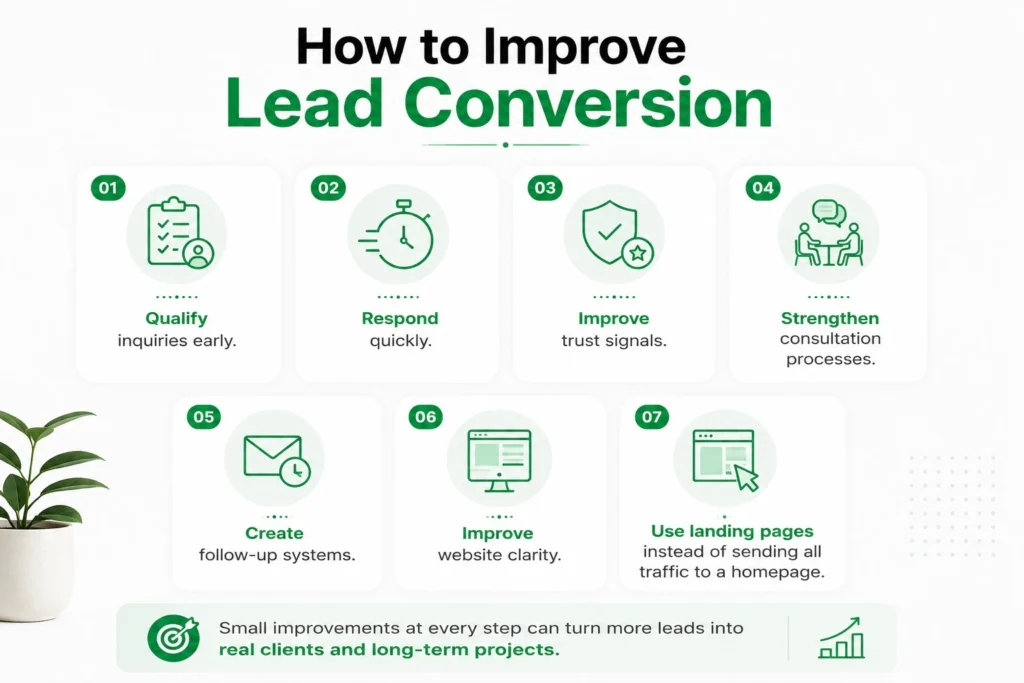
- Qualify inquiries early.
- Respond quickly.
- Improve trust signals.
- Strengthen consultation processes.
- Create follow-up systems.
- Improve website clarity.
- Use landing pages instead of sending all traffic to a homepage.
For long-term visibility, it is also worth learning the fundamentals of SEO through the Google SEO Starter Guide and educational resources from HubSpot.
FAQ
Why do interior design leads stop responding?
Common reasons include budget mismatch, lack of trust, poor follow-up, or ongoing comparison with competitors.
How quickly should interior designers respond to inquiries?
Ideally, within a few hours. Faster responses generally improve engagement and trust.
Is getting more leads always the answer?
No. Improving lead quality and conversion rates often produces better business results than simply increasing lead volume.
What information should be collected from leads?
Budget range, project location, property type, project timeline, and service requirements.
Does follow-up really make a difference?
Yes. Many homeowners take time to make decisions. Consistent follow-up often recovers opportunities that might otherwise be lost.
Final Thoughts
Digital marketing for interior designers is not simply about generating traffic, running advertisements, or increasing website visitors.
Those activities matter, but they are only part of the process.
The businesses that grow consistently understand that lead generation and lead conversion must work together.
A strong marketing system attracts attention.
A strong conversion system turns that attention into real projects.
If your inquiries are increasing but your projects are not, the issue may not be your marketing efforts. It may be the process that follows after someone becomes a lead.
Let’s Understand Your Requirements and Take It Forward
At Digital Marketing for Interior Designers, we help interior designers build systems that attract qualified leads, improve conversion rates, and create a more predictable flow of inquiries.
Whether you need better lead generation, improved landing pages, Meta Ads management, or a stronger marketing strategy, our goal is simple: to help you turn more inquiries into paying clients.